Turn clinical evidence into defensible action.
Connect claims, charts and your CMS files. See which risk dollars would survive a RADV audit, with every score checked against what CMS paid, every HCC against the chart and every claim line against its contract. Your coders review and sign off.
- HCC Validation
- MEAT Evidence
- Chart Review
- Suspect Conditions
- Documentation Gaps
- RADV Readiness
- Evidence Assurance
Evidence-linked · Human-reviewed · Matches CMS · Second-level QA · Audit-ready · BYOC
HCC 37 · Diabetes with chronic complications
Reported on claim, but no current-year encounter documents MEAT for the complication.
Claim 837P · DOS 2026-03-14
ICD-10 E11.22 reported
Progress note · 2025-11-02
p.3 — “DM2 with CKD stage 3”
Lab panel · 2026-02-20
eGFR 52 mL/min
Five things that move the money.
RADV dollars, split before CMS asks
Every submitted HCC checked against the chart, valued at the member’s own CMS rate, with an audit pack and a Compliance Report PDF.
How it works Every nightMatches what CMS paid
Each member’s score recomputed the way CMS does and compared with the MMR; each condition on the Model Output file marked confirmed, exposure or missed revenue.
How it works Missed revenueSuspects and recapture
Conditions the pharmacy and lab data point to that no one documented, and last year’s conditions not yet documented this year.
How it works Every claim linePaid what the contract says
Each line against its agreement or the Medicare rate, NCCI edits included, with the formula and the clause to cite.
How it works Your codersAccuracy you measure
Second-level QA, accuracy measured by your own certified coders, and every dollar tracked once from found to paid.
How it worksWhat CMS paid you for, and what your charts can defend.
Every score checked against CMS, every condition against the chart page, then the coder's decision and the claim payments, captured from the live product.
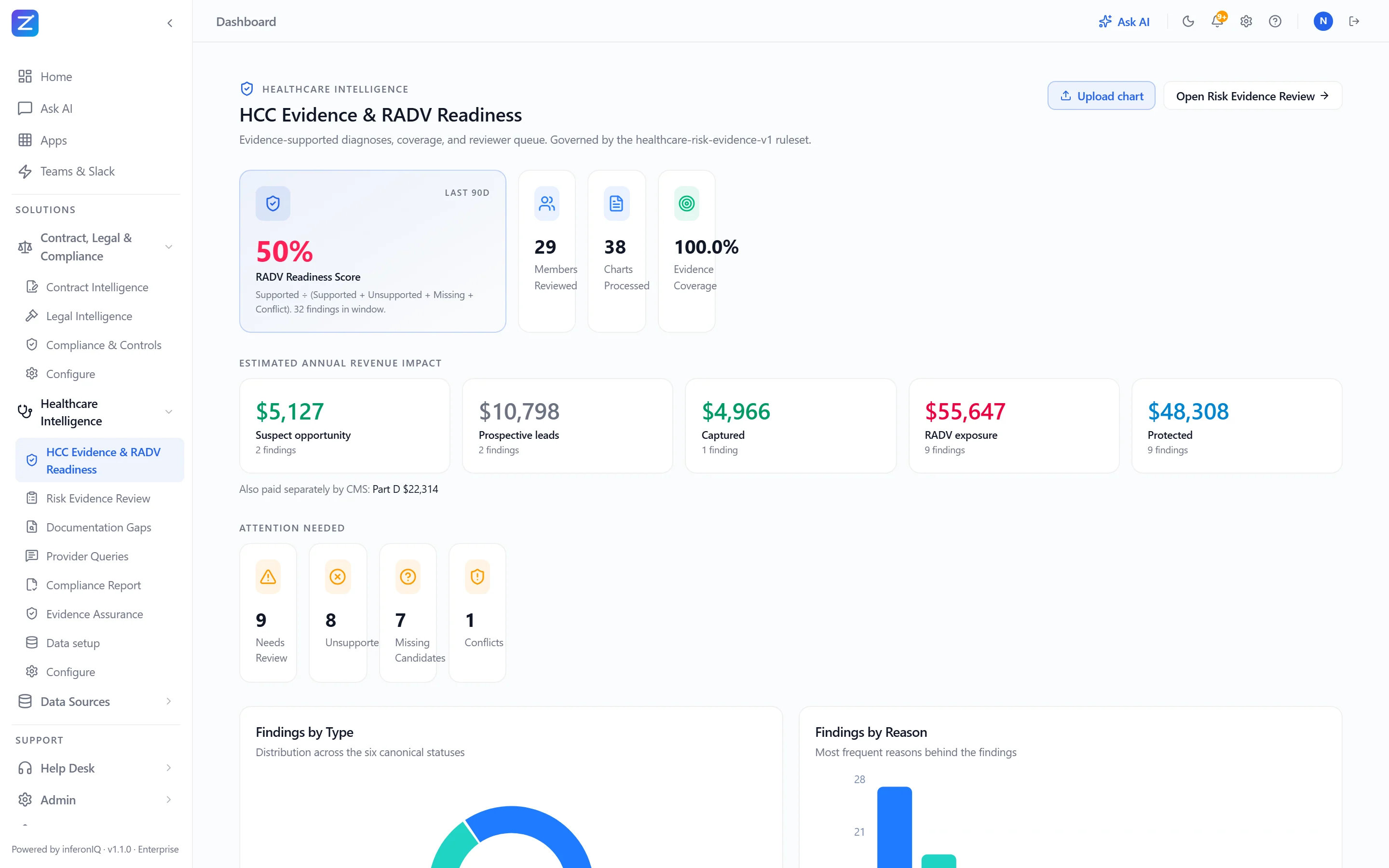
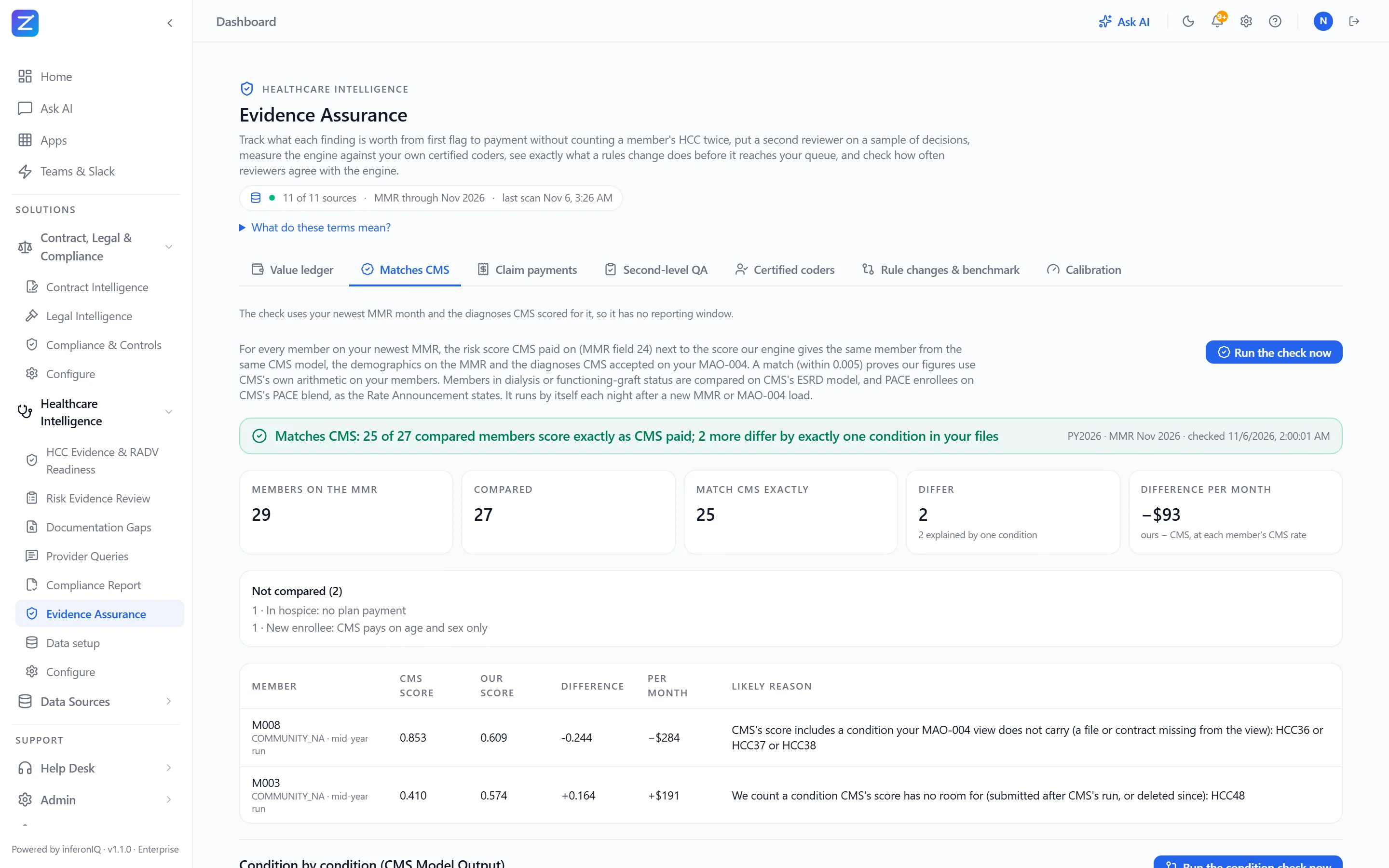
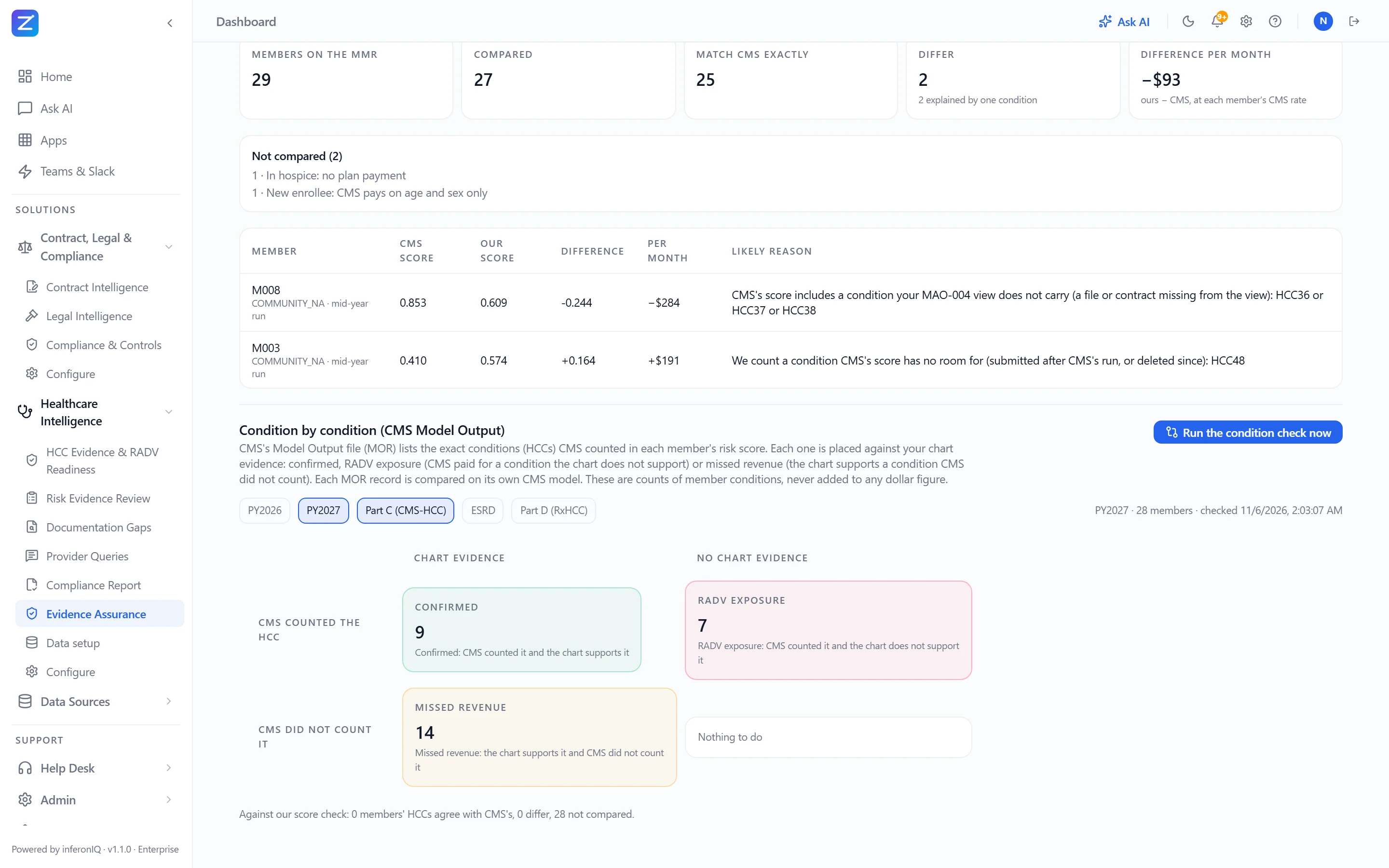
Captured from the live product on synthetic members and charts. No real patient data (PHI) is shown.
How we handle PHI.
The model sees only what the task needs, and every call is logged by task, provider and model, never by content.
BAA before any PHI
We sign a BAA with you, and every vendor that can see PHI signs one with us, before real patient data is loaded.
No retention, no training
Only AI vendors your administrator approves, under zero data retention, with no failover to any other vendor, even during an outage. Your data never trains a model.
Masked, minimum necessary
Names, dates of birth and IDs are masked as placeholders before the model reads a chart header or summarises an answer. Writing SQL, it never sees patient records.
Rules decide, not the model
HCC mapping, hierarchies, dollar values and claim prices come from CMS files and your agreements. A person decides every finding, unless you switch on auto-accept for high-confidence Supported ones.
Your cloud, your AI
Run InferonIQ in your own cloud (BYOC) with your own AI account. PHI never reaches InferonIQ; we receive only license checks.
Demos run on synthetic patients. See the FAQ for detail.
A diagnosis on the claim is not the same as a diagnosis the chart supports.
InferonIQ validates HCC-supporting documentation using MEAT-based evidence, ICD-10 to HCC mappings, source provenance and encounter context. Unsupported, conflicting, historical or incomplete diagnoses are flagged for human review — with the quoted text and page behind every call.
MEAT — Monitor, Evaluate, Assess, Treat — is the industry framework for judging whether documentation supports a diagnosis. It is not a CMS rule that every element must appear; CMS requires that submitted diagnoses be substantiated by the medical record. InferonIQ uses it to decide what a coder should look at, and a person makes the decision.
- M
Monitor
Home glucose log reviewed, fasting 140–180
Progress note · Assessment & plan · p.2
- E
Evaluate
A1C 8.1% · eGFR 52 mL/min
Lab panel · 2026-02-20 · p.4
- A
Assess
“DM2 with CKD 3a, not at goal”
Progress note · Assessment & plan · p.2
- T
Treat
Continue metformin 1000 mg BID; repeat A1C in 3 months
Medication list · p.3
“Diabetes mellitus” — problem list only, not discussed at the visit
Problem list · p.1
Everything a coder or auditor needs, on one finding.
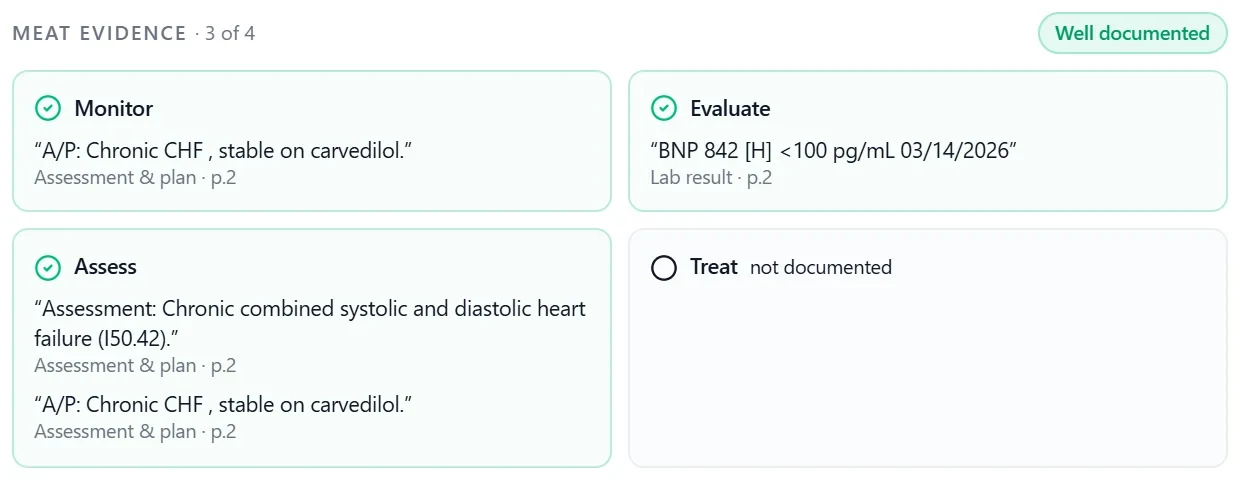
One supported heart-failure finding (I50.42, HCC226, $5,759 a year) exactly as the product shows it: the evidence quoted from the chart, the documentation checks, the member’s other conditions, the arithmetic behind the dollars, the code mapping and what the AI was allowed to see.
MEAT evidence, quoted
Monitor, Evaluate, Assess, Treat: each with the exact words and the page. What is missing is shown as missing.
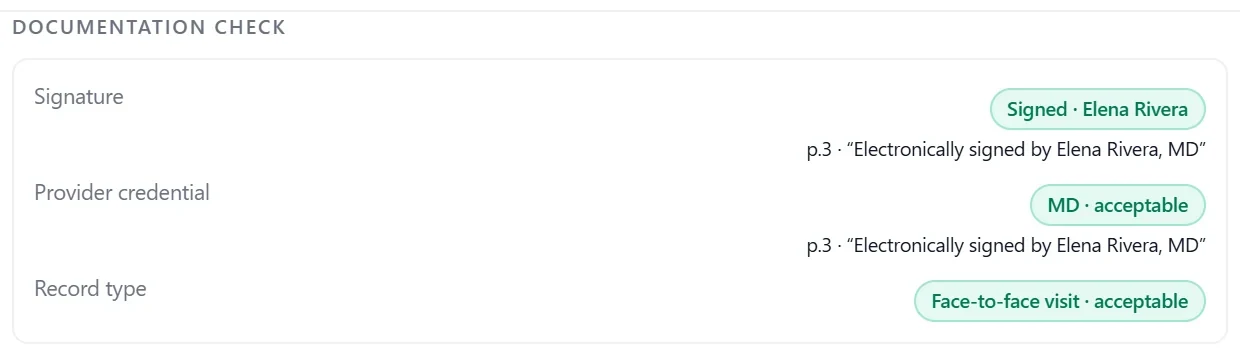
Documentation check
Signature, provider credential and record type, each with its source line, before a finding counts.
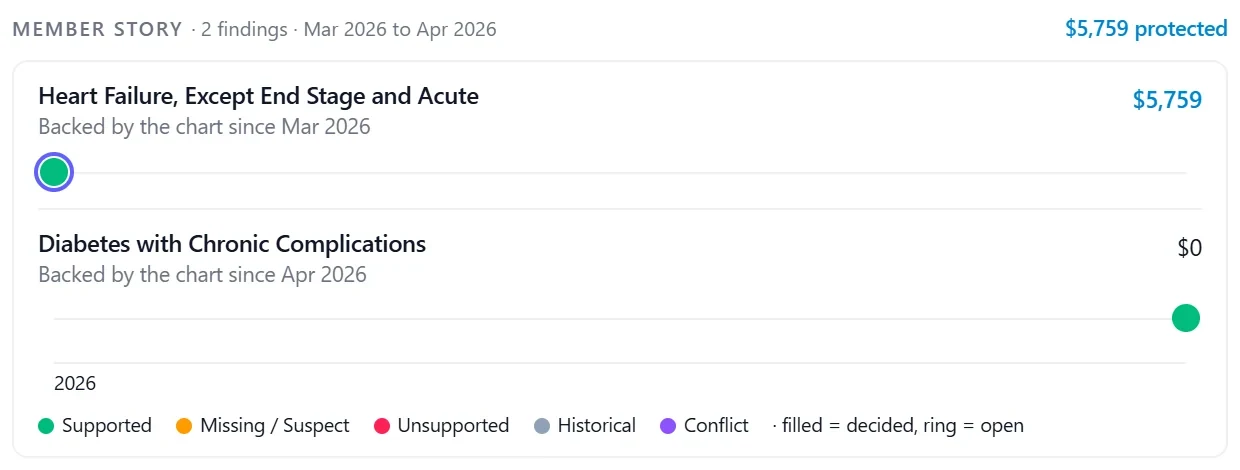
Member story
Every condition for this member, when the chart started backing it, and what it is worth.
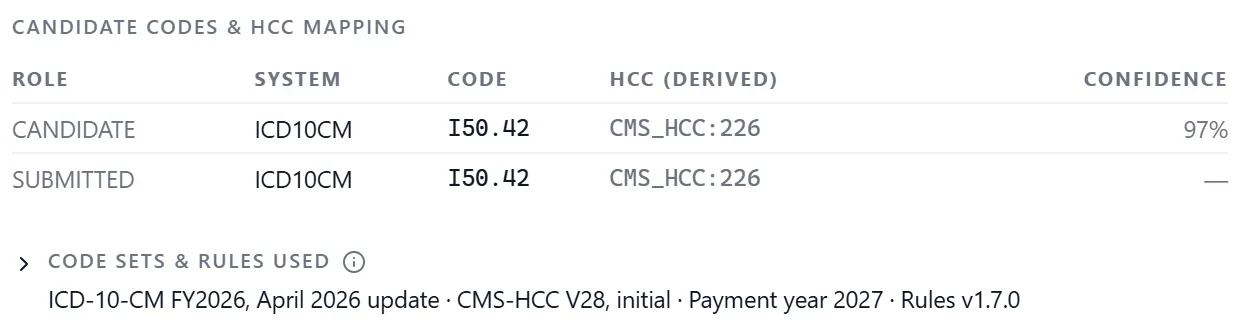
Candidate codes & HCC mapping
The code the AI found next to the code submitted, each mapped to its HCC, with the code sets and rule version used.
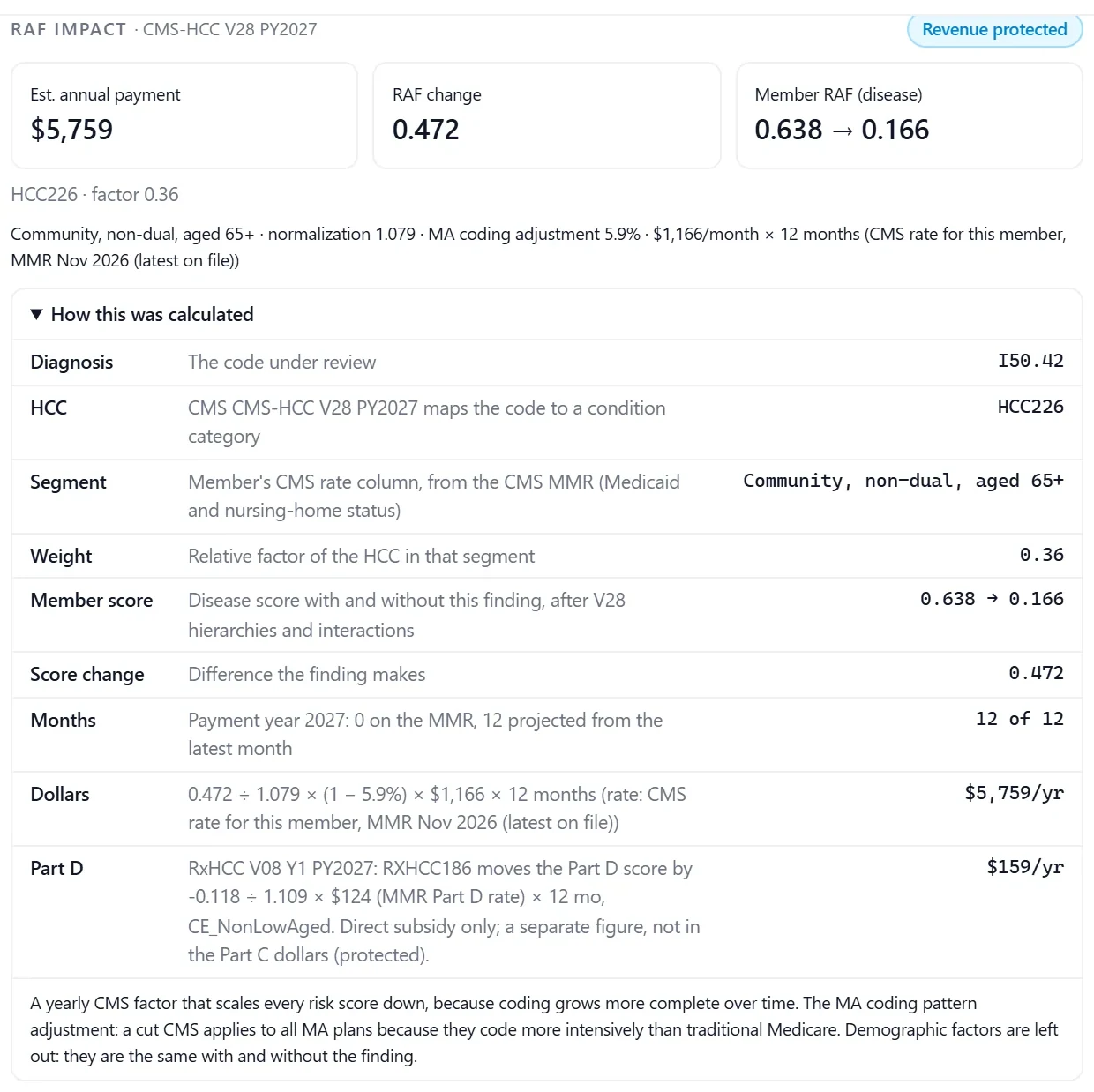
How the dollars were calculated
HCC, weight, the member’s CMS segment and monthly rate from the MMR, V28 hierarchies, normalization and the MA coding adjustment, line by line. Part D shown apart.
PHI protection & change history
Patient identifiers are replaced with placeholders before the AI reads the chart, and put back only inside InferonIQ. The model, tokens and a fingerprint of its reply are kept, and every re-valuation is recorded.
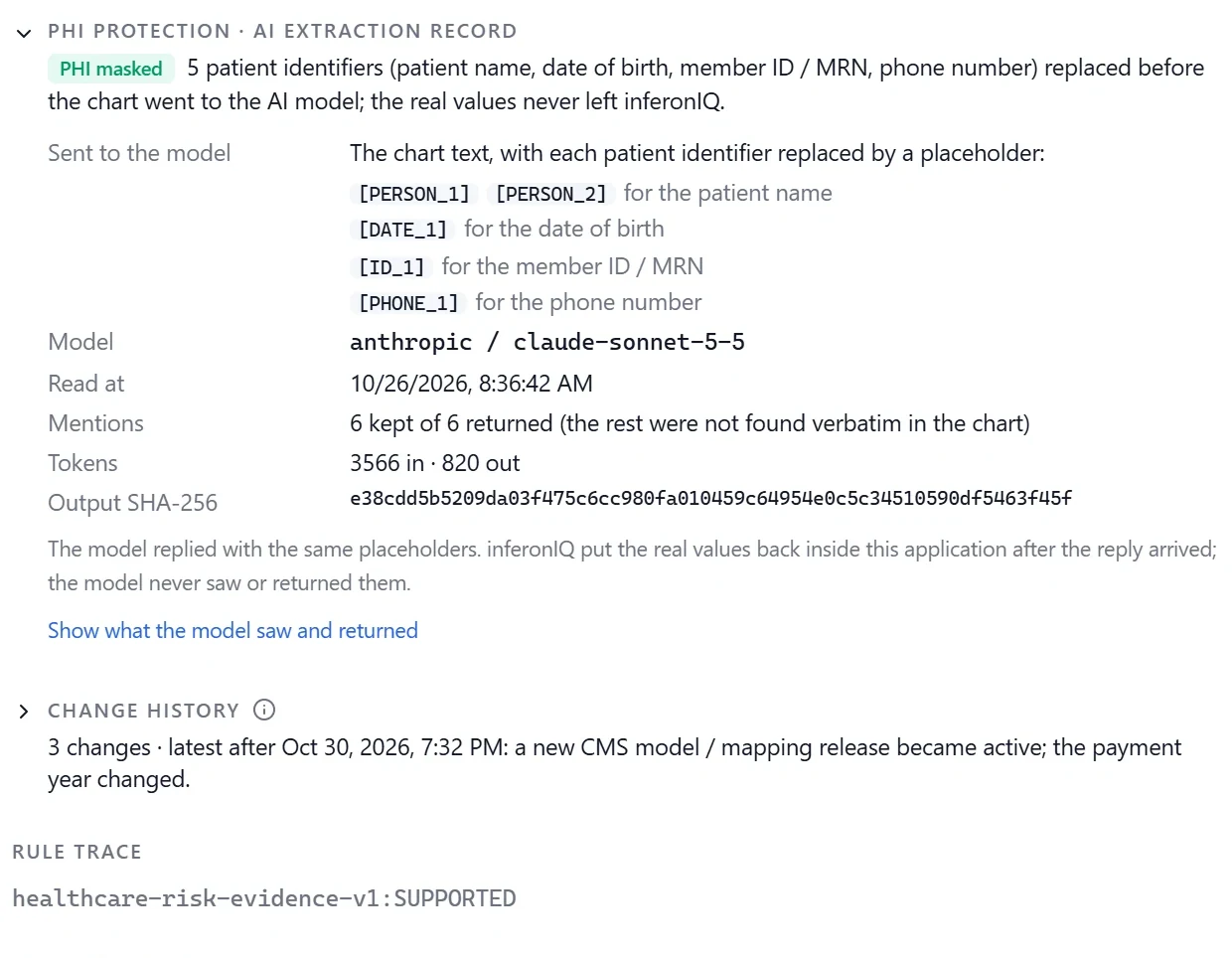
Captured from the live product on a synthetic member. No real patient data (PHI) is shown.
Your coders stay in charge of every chart.
AI reads the chart; a coder checks the reading against the page, corrects what it got wrong and decides each finding. The work moves up your review levels, and only what was agreed is exported.
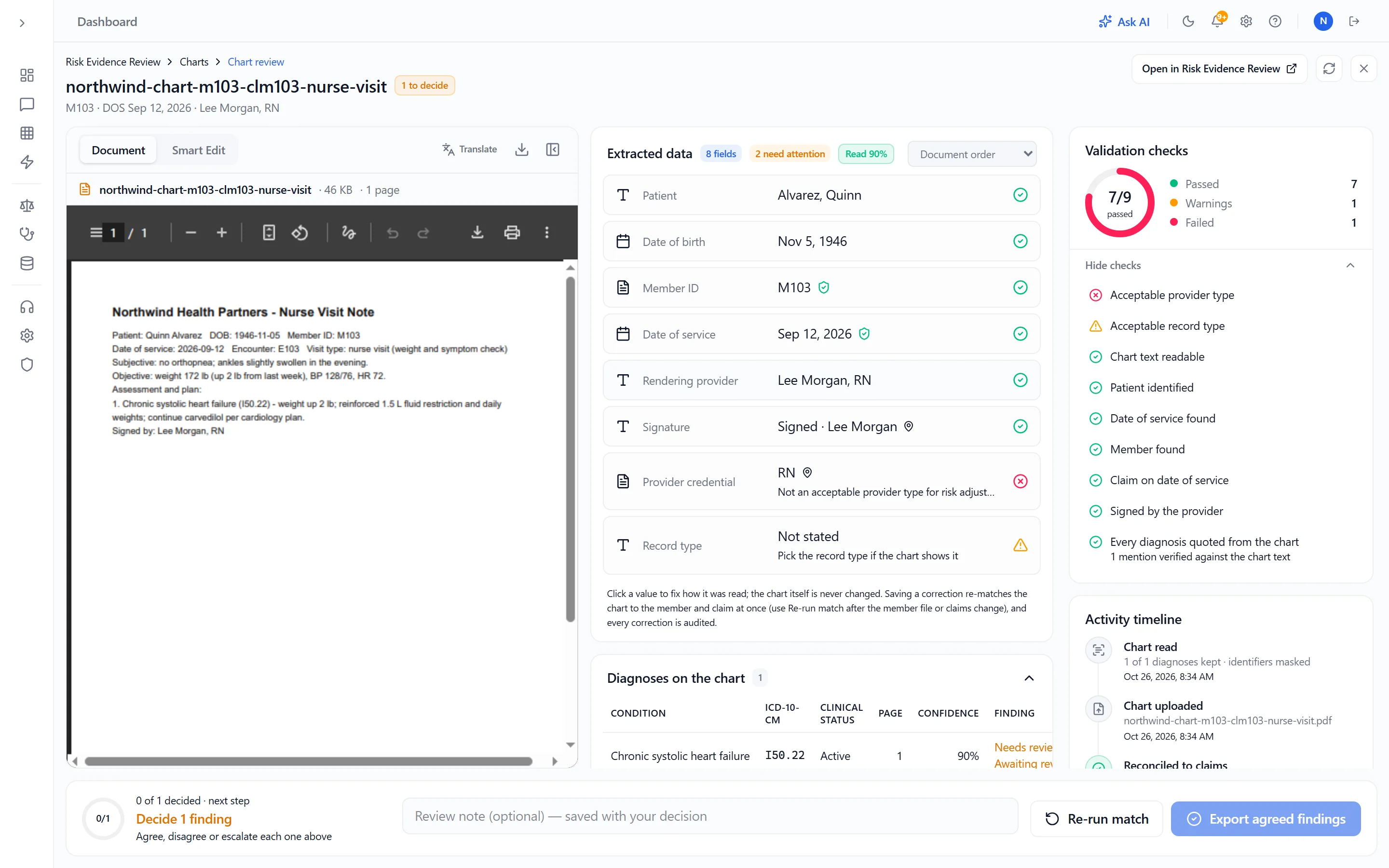
Chart review in the live product, on a synthetic nurse-visit note. No real patient data (PHI) is shown.
Every chart accounted for
One row per chart received, by upload, sync or record retrieval: read or not, tied to a member and claim, or “Not matched” with the reason. Unread charts can be read on demand.
The page beside the reading
Patient, date of service, rendering provider, signature, credential and record type, each with its confidence and page, and every diagnosis linked to its finding.
Correct the reading, never the chart
A coder fixes a misread field. The chart re-matches at once, stale findings close, decided ones stay, and the correction is audited beside the original reading.
Signed off by the right person
Chart Reviewer → Chart Approval Manager → Medical Director, or the levels you define, mapped to your identity-provider groups, with target turnarounds and escalation to a named person.
How you know the findings and the dollars are right.
RADV tests the whole program, not one code. InferonIQ checks the record, checks every member’s score against what CMS paid, puts a second reviewer on the decisions that matter and tracks every dollar from identified to realized.
Review quality
Every decision can stand a second look
- Checks the record itself
- Unsigned notes, RN, LPN or MA-only signatures and non-acceptable record types are held for review, citing CMS guidance.
- Second-level QA
- A different reviewer samples decisions, always including the high-value ones. A failed QA goes back to the queue.
- Every finding explains itself
- How to review it, the RAF calculation step by step, and a history of what changed it and why.
- Rules changes, previewed
- A locked benchmark shows exactly which cases change before a new rules version goes live.
- Auto-accept, calibrated
- If you switch on auto-accept, its confidence floor follows how often your coders agree with the engine, and QA keeps sampling.
- Measured by your coders
- Your own certified coders measure the engine’s accuracy on your charts, with a 95% range, before any figure is quoted.
Value ledger
Every dollar, from identified to realized
- Identified$5.1M
- Validated$3.8M
- Actioned$3.4M
- Resolved$3.3M
- Realized$3.2M
Each member, HCC and payment year is counted once. Illustrative figures on synthetic data.
Every night, each member’s score is checked against what CMS paid, then condition by condition against CMS’s Model Output.
Dollars use each member’s own CMS rate from your MMR, with Part D, ESRD and PACE worked out separately. The RAF arithmetic equals CMS’s own V28 scorer on 954 test members. No accuracy figure is claimed on your charts until your own coders have measured it.
Outside coders see only the findings assigned to them, and only while a BAA is in force. Approved findings go out once, as FHIR R4 or CSV.
Choose which AI vendors may process your data. Nothing goes to any other vendor, even during an outage.
Where the exposure sits today.
Every contract
Unsupported HCCs before RADV
CMS now plans to audit every Medicare Advantage contract each year, about 550 of them, and to extrapolate findings across the contract (extrapolation is paused under a September 2025 court ruling that CMS is appealing). A diagnosis without current-year MEAT evidence is a plan-level exposure, not a single-claim problem.
Every member
Scores that drift from what CMS paid
CMS pays on the score in your MMR, not the one in your analytics. A diagnosis CMS never accepted, a retroactive status change or a condition counted without chart support moves money until someone recomputes it member by member.
Every line
Claims paid off-contract
Fee schedules, percent-of-Medicare terms, DRG, per-diem and stop-loss rates and NCCI edits are hard to check by hand, so underpayments and overpayments go unseen in both directions.
Built for the teams who have to defend the number.
HCC Validation
Check every diagnosis on every claim against the doctor’s note, map ICD-10 to the CMS-HCC model for the payment year, apply CMS hierarchies and put a RAF and dollar value on every finding.
- ICD-10 → CMS-HCC V28 by payment year, hierarchies applied
- RAF and $ impact per finding, at each member’s own CMS rate
- Supported, unsupported, historical, conflicting or needs review, with page and quote
MEAT Evidence
Look for proof the provider monitored, evaluated, assessed or treated the condition — not just that it was listed. A problem-list or history-only mention is not accepted as support.
- Assessment & plan, labs, medications and imaging cited
- Quoted text with document and page
- Current-year date-of-service checks
Chart Review & Correction
Open any chart and see the source page beside everything the AI read from it: patient, date of service, rendering provider, signature, credential, record type and every diagnosis, each linked to its finding. A coder corrects how the chart was read; the chart itself is never edited.
- Charts worklist: read, tied to a member and claim, or “Not matched” with the reason
- A correction re-matches the chart at once and closes findings it no longer supports
- Identity is still checked, so a chart cannot be forced onto the wrong patient
Suspect Conditions
Surface diagnoses the chart documents — or pharmacy fills and lab results imply — that no claim carries, value each one in RAF and dollars, and send it to a coder, a chart chase or a provider query. Nothing is auto-coded.
- Documented but not submitted, or at the wrong specificity
- Pharmacy and lab signals with no claim (apixaban, eGFR, A1c)
- Opportunity valued net of V28 hierarchies
Recapture
Last year’s conditions that CMS paid on, or a coder accepted, that no qualifying visit has documented yet this year, and members who have not been seen yet, each with the dollars at risk next year.
- From the diagnoses CMS accepted (MAO-004) or last year’s accepted findings
- Members with no qualifying visit within your rule
- In the same retrieval worklist, exported the same way
Documentation Gaps
Turn unsupported and chart-less diagnoses — and conditions only pharmacy or lab data shows — into a ranked list of charts to fetch, exported to your retrieval team or vendor, and track every request until the returned chart has been read and reviewed.
- One request per chart, ranked by HCC and RADV risk, dollar value shown
- CSV export and status re-import for retrieval vendors such as Cotiviti or Reveleer
- Returned charts matched and read automatically
Provider Queries
Where the note falls short, or pharmacy and lab data point to a condition nobody documented, send the treating provider a neutral question and track it to an answer. Providers never see dollars or HCC codes.
- Clinical indicators and a question that asks for clinical judgment
- Options always include another diagnosis, not present and unable to determine
- Closes on its own once a reviewed chart documents the condition
RADV Readiness & Compliance Report
Know which risk dollars would survive a RADV audit. Trace every finding back to member, encounter, document, page and evidence, and hand auditors a PDF Compliance Report.
- Safe versus at-risk dollars across open findings
- An audit pack per finding: member → encounter → page, with the reviewer’s decision
- PDF Compliance Report for auditors
Dollars the Way CMS Calculates Them
Every finding is valued on the payment year’s CMS-HCC model, with normalization and the MA coding adjustment, at each member’s own CMS rate from your Monthly Membership Report (MMR). Part D, ESRD and PACE are worked out separately.
- Each member’s rate and segment from the MMR; your base rate only where the MMR does not cover a member
- Part D (RxHCC) and ESRD each have their own figure, never added into Part C
- PACE enrollees on CMS’s PACE blend for the year
Matches CMS & Model Output
Every night, recompute each member’s risk score from your MMR and MAO-004 and check it against the score CMS paid. Then compare condition by condition with CMS’s Model Output (MOR) file.
- Each difference explained, with CMS’s later corrections applied
- MOR: confirmed, RADV exposure or missed revenue for every condition CMS counted
- CMS files uploaded or picked up from your SFTP, network drive, SharePoint, OneDrive, Google Drive or S3
Evidence Assurance
Prove the program itself is right: the record is checked, a second reviewer samples decisions, your own certified coders measure accuracy, a rules change is previewed before it reaches the queue, and every dollar is tracked from found to paid.
- Signature, credential and record-type checks, citing CMS guidance
- Second-level QA, and accuracy measured by your own certified coders
- Value ledger, each member / HCC / year counted once; optional auto-accept calibrated to how often coders agree
Reviewer Guidance & History
Every finding explains itself: what Agree and Disagree mean, how to review it, the RAF calculation step by step, and a history of what changed it and why.
- “How to review this finding”, written for the coder
- Step-by-step RAF and estimated dollar calculation
- Change history with the cause: rules, CMS / ICD release, base rate, segment or a new chart
Sign-off, Escalation & Export
Every finding has an owner. Review levels follow your identity-provider groups, for example Chart Reviewer, Chart Approval Manager and Medical Director, each with a target turnaround. Reviewers agree, disagree or escalate to the next level or a named person, and agreed findings leave through your own export profiles.
- Named owners and a personal work queue, with people and groups synced from your IdP
- In-app and email notifications that carry no PHI
- Outside coding vendors, under a BAA, see only the findings assigned to them
Claim Payments
An N-way match on each claim line: claim ↔ its contract (fee schedule, percent of Medicare for doctor, lab and drug prices, and hospital stays by MS-DRG, per diem or stop-loss) ↔ Medicare’s price lists ↔ CMS’s NCCI edits. Out-of-network lines are checked at Medicare rates. Every line shows its formula and contract clause.
- Paid below or above the agreement, with the clause and page to cite
- Medicare price lists: Physician Fee Schedule, Clinical Lab, drugs at ASP + N%, MS-DRG
- NCCI code pairs and unit limits; lines that cannot be priced exactly are shown as not priced, with the reason
Contract & Legal Intelligence
Payer and provider agreements read automatically: rates, covered doctors and plans, obligations, renewal deadlines and BAAs. RADV audit notices, disputes and arbitration documents are summarized with their deadlines.
- The rates claim payments are checked against, read from the agreement
- Renewal and notice deadlines tracked
- Audit, dispute and arbitration documents summarized
Healthcare Ask AI & Agent Studio
Ask questions across claims, encounters, labs, medications, claim payments and clinical documents in plain English, set nightly alerts, and build your own apps without developers.
- Claims + chart in one question
- Governed, PHI-aware answers, every number traced to its source
- Nightly alerts and Agent Studio apps
What applies to your organization.
Medicare Advantage plans use all of it. Provider groups, specialty practices and ACOs use the parts their data and contracts support, and we say plainly where something does not apply yet.
Regional & hospital-owned MA plans
“Know which of your risk dollars would survive a RADV audit, and whether you pay your doctors and hospitals what your agreements say.”
Everything: chart evidence, suspects, recapture, RADV, dollars at each member’s CMS rate, Matches CMS, claim payments, contracts and legal.
Blue Cross plans
“A second opinion on your current vendors, where every dollar shows its formula and its source.”
Everything, often beside existing risk and payment-integrity vendors: Matches CMS, the Model Output comparison and claim payments, with accuracy measured by your own coders.
PACE organizations
“Nearly all your revenue rides on risk scores, and you pay outside hospitals at Medicare rates. We check both every night.”
Risk scores on CMS’s PACE blend, ESRD and Part D apart, plus outside hospital stays and specialists checked at Medicare rates.
Special-needs, dual & smaller MA plans
“A risk-adjustment and payment check sized for a plan without a large analytics team, running every night.”
Everything, with ESRD and Part D worked out separately and recapture front and centre.
Doctor groups paid on risk scores
“Your income depends on documentation your doctors already did. We find what is missing and what an audit would take back.”
The coders’ daily worklist: find the record, review it, query the doctor, audit-ready. Plus the specialist and hospital claims you pay out of capitation, and your plan agreements.
Dollars and Matches CMS need the plan to share its MMR and MOR files.
ACOs (MSSP & ACO REACH)
“Make sure your benchmark reflects how sick your patients really are, backed by notes that hold up to review.”
Documentation accuracy, suspects, recapture, provider queries, audit-style readiness and coder QA. Strongest for REACH, where risk scores drive the benchmark.
No MMR dollars. Claims come from CMS’s CCLF files, picked up from your folder, or a database we connect to.
Specialty groups & clinics
“Is every plan paying you what your contract says?”
Claim payments and contracts from the practice’s side: every paid line against the fee schedule or the Medicare rate it points to, drugs at ASP + N% included, each shortfall with its formula and clause.
Paid amounts come from your 835 remittances, picked up from your folder, or a billing-system extract.
National insurers
“An independent, explainable check of your risk-adjustment and payment-integrity results, run inside your own cloud.”
A pilot on one contract or region: Matches CMS, the Model Output comparison and rule-change previews against your vendor’s or your own results.
| At a glance | Risk adjustment & RADV | Claim payments | Contracts & legal |
|---|---|---|---|
| Regional & hospital-owned MA plans | Full | Full | Full |
| Blue Cross plans | Second opinion | Second opinion | Full |
| PACE organizations | Full | Outside hospitals | Full |
| Special-needs, dual & smaller MA plans | Full | Full | Full |
| Doctor groups paid on risk scores | Dollars need plan files | Claims you pay | Full |
| ACOs (MSSP & ACO REACH) | No MMR dollars | Rarely | Full |
| Specialty groups & clinics | Not applicable | Your side | Full |
| National insurers | Pilot | Pilot | Full |
We read your files straight from your SFTP, network drive, SharePoint, OneDrive, Google Drive or S3 folder: CMS’s Medicare Advantage files (MMR, MAO-004 and Model Output), the 835 remittances payers send, and the CCLF claim files CMS sends ACOs. What we do not do: change a claim on our own (a person decides every finding) or run our own DRG grouper (hospital stays use the DRG billed on the claim).
- Record needed
- Requested
- Received
- Analyzed
- Closed
M-20418 · Office visit · DOS 2026-03-14
HCC 37 · HCC 329 · No chart on file
HighRecord neededM-11873 · Cardiology consult · DOS 2026-01-22
HCC 226 · No current evidence
HighRequestedM-30952 · Office visit · DOS 2026-02-05
HCC 409 · Amputation status undocumented
MediumReceivedM-09617 · Office visit · DOS 2025-12-09
HCC 155 · Insufficient evidence
LowAnalyzed
When the evidence is not in the chart, go and get it.
Unsupported findings and claims with no chart on file become one record request per encounter, ranked by HCC value, RADV sensitivity and date of service.
- Filter and export a retrieval list for your vendor or provider outreach team
- Re-import statuses from the vendor file; nothing is re-keyed
- Returned charts are matched to the open request and re-reviewed automatically
- Each request is timestamped at every stage, from record needed to closed
Evidence in. Reviewed action out.
Every diagnosis is reconciled across claims, encounters and the chart, evaluated against HCC rules and MEAT criteria, and classified into a finding a coder can act on — with the evidence ready for audit when it is approved.
- 1ConnectClaims · 835 remittances · ACO CCLF files · Encounters · Labs · Medications · Clinical PDFs · CMS MMR, MAO-004 & MOR · Agreements
- 2UnderstandDocument AI · Clinical concepts · ICD-10 · Member timeline
- 3ReconcileClaims ↔ Encounter ↔ Clinical evidence ↔ What CMS paid
- 4EvaluateHCC rules · MEAT · Current-year evidence · Agreement & Medicare rates · NCCI
- 5FindingsClassified, evidence-linked, ranked by impact, each with an ownerSupportedUnsupportedMissing candidateHistoricalConflictNeeds review
- 6ActChart review & correction → Sign-off or escalation → Record request → Provider query → Export & audit evidence
Ask across claims and the chart in the same sentence.
The same NL2SQL and Document AI engine behind Enterprise Intelligence, tuned for clinical vocabulary. Structured tables and unstructured notes are answered together, and every number links back to the rows and pages it came from.
Risk Adjustment
Which reported HCCs lack current-year clinical evidence?
RADV
Show every document supporting HCC 85 for this member.
Coding
Which members have diabetes complications documented but not coded?
Suspects
Which members have pharmacy or lab evidence of a condition nobody documented this year?
Payment integrity
Which claim lines were paid below the agreement this quarter, and by which plan?
Designed for audit from the first query.
Every finding has a source
Member, encounter, document, page and quoted text are attached to each result. Nothing is asserted without evidence.
People make the call
AI proposes; coders agree, disagree, correct or escalate, and sign-off follows the review levels you set. Every decision is attributed and timestamped.
Full audit trail
Every chart read by AI (model, time and the exact output), every reading correction, Ask AI questions and answers, reviewer and QA decisions and exports are logged for compliance and RADV defence.
Read-only connections
Connectors read from EHR, claims and document stores. Corrections are kept beside the AI’s reading inside InferonIQ; the source chart is never edited and nothing is written back to a claim.
Was every claim paid what the agreement says?
The same deployment checks claim payments against your agreements and Medicare’s own price lists, reads the agreements themselves, and summarizes audit notices and disputes. Plans check what they paid; practices check what they were paid.
Claim payments
An N-way match on every claim line: its agreement or the Medicare rate it points to, and CMS’s NCCI edits, with the formula and clause behind each dollar.
Learn morePayer & provider contracts
Rates, covered doctors and plans, obligations, renewal deadlines and BAAs, read from your agreements.
Learn moreAudits, disputes & arbitration
RADV audit notices, disputes and arbitration documents summarized by Legal Intelligence, with their deadlines.
Learn moreSupplier & GPO pricing
For hospital networks: an N-way match on every medical-supply invoice, invoice ↔ PO ↔ receipt ↔ GPO or contract rate, with Enterprise Intelligence.
Learn moreOffice visit, CPT 99215, matched four ways: the agreement’s fee schedule (§4.2, p. 7) sets $189.00, no NCCI edit applies, and the plan allowed $178.00. The line was paid $11.00 below contract, with the formula and the clause to cite. Synthetic data.
N-way claim match on every line, every night
- N-way claim match on every line: claim ↔ agreement ↔ Medicare price list ↔ NCCI edits
- Fee schedule and percent-of-Medicare terms read from each agreement, with the clause and page
- Medicare price lists: Physician Fee Schedule by locality, Clinical Lab Fee Schedule, drugs at ASP + N%
- Hospital stays: MS-DRG (the DRG billed on the claim), per diem and stop-loss
- Out-of-network Medicare Advantage lines against what Original Medicare would pay
- CMS NCCI edits: procedure-to-procedure pairs and medically unlikely units
- Lines that cannot be priced exactly are shown as not priced, with the reason; nothing is estimated
- A person decides every finding; nothing changes the claim
Ask payment integrity
- Which claim lines were paid below the agreement this quarter, by plan?
- Show NCCI potential overpayments by procedure pair
- Which out-of-network lines were paid above the Medicare rate?
- Which payer agreements renew in the next 90 days?

Clinical review and payment integrity, from one deployment.
Medicare Advantage plans, PACE organizations, provider groups and ACOs.
Not a second product. The same platform.
Healthcare Intelligence runs on the NL2SQL, Document AI, Agent Studio, workflow and governance layers that power Enterprise Intelligence — so revenue-cycle, supply-chain and contract teams can work from the same deployment.
Healthcare Intelligence — frequently asked questions
MEAT, V28, CMS-rate dollars, Matches CMS, recapture, chart chase, provider queries, claim payments, RADV and PHI
How do we know the findings and dollar values are right?
What is MEAT in risk adjustment?
Does InferonIQ support CMS-HCC V28?
How is the RAF dollar value of a finding calculated?
Do your figures match what CMS paid?
What is recapture?
What does the claim payments check do?
Can a practice check whether plans paid it correctly?
Does it work for PACE organizations and ACOs?
What is a chart chase, and how does InferonIQ help?
Can pharmacy and lab data find suspect conditions?
How do provider queries work? Is this CDI?
Does InferonIQ code charts automatically?
What happens when the AI misreads a chart?
How are findings assigned, signed off and escalated?
Can an outside coding vendor work in InferonIQ?
How does InferonIQ help with RADV audits?
Which data sources does it connect to?
Will you sign a BAA?
Do you send PHI to AI models?
Where does our PHI live?
Does InferonIQ support ACA (HHS-HCC) risk adjustment?
Have more questions? Contact us
See which of your risk dollars would survive a RADV audit.
We start on synthetic data: every score checked against what CMS paid, every condition against the chart. When you are ready, a scoped pilot runs on your own MMR, Model Output files and charts, under a BAA or in your own cloud, and your coders score it.